According to the Film industry, mise en scene consists of the things that are shown on the camera, including that of compositions, sets, props, actors, costumes and lighting. It also helps the viewers of the film to feel as if they are actually there, thanks to the idea of there being the idea of time being there.
Key aspects
Set design- which can consist of actually setting the scene of the film, for example sorting out the props to be put in certain places. The set can be used to show a character's personality. The set is normally set up through the idea of the director of the film.
Lighting- which can be used to show the character's mood, their personality and also can be used to set the scene.
Costume-refers to the clothes that characters wear. Different colours or designs are used to signify characters or to make clear distinctions between characters.
Friday, 27 December 2013

Cinematography
Cinematography is often referred to as the art of motion picture photography. It often comes down to the shooting and development of the film. Every film has a different perspective to it, the director may wish to use different styles of filming.
Most films tend to use all different styles of effects and special effects as a way to try to make their movies seem much more realistic than they actually are. (however too many effects or special effects can definitely make the film seem incredibly unrealistic)
More ways that filming can be used is that different lenses and filters can be used on the cameras in order for them to be able to set the mood of the film. They can also do things like show us what times of day it is for example the lights could be darkened in order for it to show that it is later.
Most films tend to use all different styles of effects and special effects as a way to try to make their movies seem much more realistic than they actually are. (however too many effects or special effects can definitely make the film seem incredibly unrealistic)
More ways that filming can be used is that different lenses and filters can be used on the cameras in order for them to be able to set the mood of the film. They can also do things like show us what times of day it is for example the lights could be darkened in order for it to show that it is later.
Saturday, 21 December 2013
Source Code
Source Code
The film Source Code is about an army soldier called Colter Stevens (Jake Gyllenhaal) who wakes up and finds himself in some sort of capsule. He later finds out that he is a part of the Source Code project in which somebody could live the last 8 minutes of someones life. He has to go into the body of someone on a train, however the train is subject to a terrorist strike, so now he must find the bomber of the train and stop him from doing another bombing in Chicago.
Source Code Trailer
The trailer to this film is effective as it tells us the basic story of the film "Source Code"and will get an audience to go to see the film. The trailer has been edited in a certain way that it starts off slow at first but as the music starts to build up and get more and more tense, the trailer's number of cuts is getting shorter and quicker. I think that the target audience of this film is people aged 12 and up, because of the action that you see in the trailer.
Box office
The budget of the film was estimated to be about $32,000,000. On the opening weekend the film received $14,812,094 but then eventually grossed to about $54,696,902.
The film had an enigmatic ending to it, in a way that it brings up more questions than answers, however it ends up being a happy but confusing ending. The ending didn't make that much sense in reality, but it seemed correct to end the movie off like how it did because it ended the movie on a positive note despite the fact that the protagonist of the story died.

Box office
The budget of the film was estimated to be about $32,000,000. On the opening weekend the film received $14,812,094 but then eventually grossed to about $54,696,902.
The film had an enigmatic ending to it, in a way that it brings up more questions than answers, however it ends up being a happy but confusing ending. The ending didn't make that much sense in reality, but it seemed correct to end the movie off like how it did because it ended the movie on a positive note despite the fact that the protagonist of the story died.
Source Code movie poster.
Thursday, 19 December 2013
Shifty
Shifty
Shifty, a young crack cocaine dealer in London, sees his life quickly spiral out of control when his best friend returns home. Stalked by a customer desperate to score at all costs, and with his family about to turn their back on him for good, Shifty must out-run and out-smart a rival drug dealer, intent on setting him up for a big fall. As his long time friend Chris, confronts the dark past he left behind him, Shifty is forced to face up to the violent future he's hurtling towards.
Microwave scheme
Shifty was made in 2008 under the microwave scheme. The microwave scheme was set up to widen participation and access for young, London based filmmakers. The scheme offers support for films to be made in 18 days and with less of a budget than £100,000.
Box Office
The film was directed by Evan Creevey and was released on 24th of April 2009. On the opening weekend the film received £61,000 and the final box office eventually £143,000.
Marketing
The marketing of the film was helped with the idea of cross media convergence, there were Posters, it was on the radio, they had a website for the film, they used social media to advertise their film as well as the idea of using email to advertise their film. They also used the idea of music on the film thanks to people being able to download the mp3s, able to by the music soundtracks on CDs and finally being able to access the music video on youtube.

Dreams of a life
Dreams of a life
A filmmaker sets out to discover the life of Joyce Vincent, who died in her bedsit in North London in 2003. Her body wasn't discovered for three years, and newspaper reports offered few details of her life - not even a photograph. The film was directed and written by a British film make called Carol Morley.
The film was based on the true story of the life of Joyce Vincent who did actually die in her bedsit in North London, she was a relatively popular person so it was indeed strange that she died all alone without a trace.
Cross media convergence
The film was further given more publicity thanks to the idea of the internet. It was further brought to a website www.dreamsofyourlife.com. After this they even brought out a mobile app 'Would anyone miss you?' both of these versions of cross media convergence were from the digital agency Hide & Seek.
Dogwoof Pictures
Dogwoof Pictures was founded in 2004 by Andy Whittaker and Anna Godas and originally concentrated on foreign films. However now they do British Films also. In July 2005 the company experimented by distributing James Erskine's EMR simultaneously in cinemas, on the internet and also on DVD.
Box Office
On the opening weekend of this film they made $3,085, then it further grossed to $6,595. Company Credits: Cannon and Morley Productions, Irish Film board and Soho Motion Pictures.
Problems in Marketing
It was difficult to market this film, it was hard to find a target audience and the film had quite a low budget so therefore couldn't afford any large advertising campaigns. However they did manage to get around this problem by using a Conventional website, an innovative idea of using a mobile game and thanks to effective use of interaction through the audience.
Wednesday, 18 December 2013
No Country For Old Men
No Country for Old Men
I watched the movie 'No Country for Old Men' which is about a hunter Llewelyn Moss (Josh Brolin) who ends up finding a drug deal gone wrong, many people and animals are dead, he finds the money which added up to $2 million. He takes the money home to his trailer. He then finds out that a hired hitman Anton Chigurh (Javier Bardem) has been given the job to retreive the money back from him.

The movie poster is effective as it gives the audience an idea of no escape, hence the idea of Bardem's eyes in the background as if he is always looking around the place so like there is no place to hide. The fact thta Brolin is small in the poster is also an idea of him constantly running away from Bardem.
In the film, Javier Bardem plays a ruthless hitman who will kill anyone that gets in his way from stopping him from achieving his objective. His character is an extremely calm person despite the sort of work he does, thanks to his calmness whenever he is on screen he makes the audience incredibly uneasy because through his calmness it feels like that he may just snap and kill everyone. His voice is also incredibly calm and neutral even when he is about to kill somebody.
Monday, 16 December 2013
Collateral
Collateral (2004)
We was given the film "Collateral" to watch in lesson, it is about a LA cabbie called Max Durocher (Jamie Foxx) who has been driving the cabs for 12 years who picks up a well dressed man who would pay him $600 if he was his only passenger for the night plus another $100 if he makes it to the airport on time. This well dressed man is a hitman who is called Vincent (Tom Cruise). He wants Max to drop him off at all of his stops so then he is able to assassinate his targets.
The film opened on August 6, 2004, in 3,188 theaters in the United States and Canada and grossed approximately $24.7 million on its opening weekend, ranking #1 at the box office. It remained in theaters for 14 weeks and eventually grossed $101,005,703 in the U.S. and Canada. In other countries it grossed a total of $116,758,588 for a total worldwide gross of $217,764,291.
The film opened on August 6, 2004, in 3,188 theaters in the United States and Canada and grossed approximately $24.7 million on its opening weekend, ranking #1 at the box office. It remained in theaters for 14 weeks and eventually grossed $101,005,703 in the U.S. and Canada. In other countries it grossed a total of $116,758,588 for a total worldwide gross of $217,764,291.
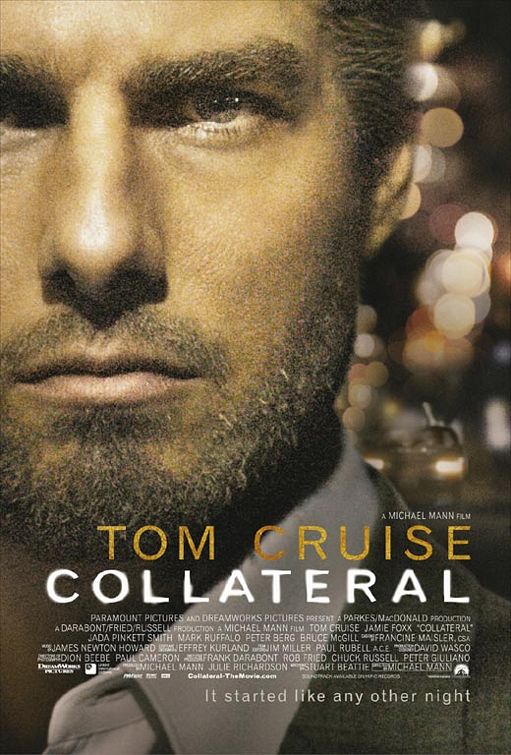
The movie poster of this film is effective as it shows one of the major stars of the film, Tom Cruise, who was one of the top movie stars at the time. Since the poster only mainly shows his face this would make people realise that he is in the film and would draw some of his fans toward this film. The only other part that we see in this poster is some sort of blurred out background making us again focus on Tom Cruise.
Thursday, 28 November 2013
Preliminary Task Evaluation
Our preliminary task is about a conversation in which person A and person B end up swapping items. The point of this task was to show continuity editing, match on action, shot/reverse shot, 180 degree rule and an eyeline match.
We did a match on action straight at the beginning when person A walks through a closed door and opens it, so we see the characters back when she opens the door, then we cut to her walking through the door on te inside of the room to see her shut the door.
We also had both of the characters have a conversation in which we used a shot/reverse shot. I think that we did end up doing this part correctly. Also we did not break the 180 degree rule so the film looks more realistic.
The eyeline match was of both of the characters looking at each other, I think that we could of improved this part as we could of made the eyeline match longer and used more cuts for it.
When we was editing it we realised that we did not do the continuity editing that well as when character A walks through the door there is nothing on the tables around character B, but then as character A walks out of the room there is a book on one of the tables and a bit of blue tack on the table. Again another issue with the continuity editing was that during the shot/reverse shot that after a while we did not notice the book randomly appearing during the shots.
What I would do for next time is that I hope to sort out the issues with the continuity editing and move the books that appeared in the shot and also I would like to make the eyeline match longer.
Thursday, 21 November 2013
Continuity editing
Is when the film is made to retain a sense if realistic chronology and gives the feeling that time is moving forward, it can use flashbacks or flash forwards but it will still be seen progressing forward.
Eye line match
We see a character looking at something off screen and then we cut to a shot of what they are looking at.
Match-on action
We see a character start in one shot and then see them continue to the next.
Graphic match
When two shots are linked with a similar shape or composition of an image.
180 degree rule
It is a basic guideline that says that two characters in the same scene should always have the same left/right relationship to each other.
Shot/reverse shot
Are used to show conversations and or arguments in a scene.
Wednesday, 20 November 2013
Style of editing
The style of editing is basically how the shots from the film are all linked together, the movement from one shot to the next is called a transition.
Straight cut
The most common form of transition, it is where one shot moves instantaneously to the next without the audience noticing. Straight cuts are used to help retain reality. They do not break the viewers suspension of disbelief.
Dissolves
Are basically when a shot fades off the screen whilst another shot fades in. The audience will be able to see both shots during the mid point of the dissolve. It can be used to show a connection between characters, places or objects.
Fades
Are a gradual darkening or lightening of an image until it becomes black or white, one shot will fade until only a black or white screen can be seen. It can be used to show the end of a particular section of time within the narrative or it can show the passing of time.
Wipes
Furthermore another style of editing can be seen in wipes where one image is pushed off the screen by another. It is most common for the image to be pushed off to the left hand side as this movement is more consistent with the sense of time moving forward. It can be used to signal a movement between different locations that are experiencing at the same time.
Jump cut
This is where the audiences attention is brought into focus on something very suddenly. This occurs by breaking continuity editing, it is also known as discontinuity, it appears as if a section was removed from the film.
Graphic match
A filmmaker may choose to place shots in a certain order to make a smooth visual transition from one frame to another, this is called a graphic match.
Montage editing
Basically where there are different images quickly edited together, it does not give a sense of the narrative moving forward but still has meaning. They are often used to reflect on chaos, tension or disturbance or a characters state of mind.
Speed of editing
In films, a scene may last a few seconds, or it could last for several minutes on end. Depending on the length of the sequence it establishes the pace at which a film is happening.
The speed of editing will help to determine the mood of what is taking place on screen.
If the audience needs to feel anxiety and to be full of suspense the editing will indeed be very quick and the scenes and the shots will constantly be changing throughout the sequence. If the audience is to feel relaxed, the scenes would last a lot longer and would change less frequently.
On the other hand however a film may not need any editing and could just be filmed in one constant take, however due to the lack of jumps the film may seem boring.
However a trailer for a film needs to show what happens throughout the film in a number of minutes so therefore the editing will indeed be very fast.
Scenes at the beginning of films need to help us see the story that is trying to be told throughout the film, so they must be long enough for us to understand what is going on throughout the beginning to get us used to the story, however as the film progresses scenes may become shorter due to the story becoming more developed.
Wednesday, 13 November 2013
The Manchurian Candidate
On the Thriller subject I watched the start of two versions of the film 'The Manchurian Candidate'. I watched the 1962 and the 2004 version of the film to see which one was more appealing to me.
Major Ben Marco is an intelligence officer in the U.S. Army. He served valiantly as a captain in the Korean war and his Sergeant, Raymond Shaw, even won the Medal of Honor. Marco has a major problem however: he has a recurring nightmare, one where two members of his squad are killed by Shaw. He's put on indefinite sick leave and visits Shaw in New York. Shaw for his part has established himself well, despite the misgivings of his domineering mother, Mrs. Eleanor Shaw Iselin. She is a red-baiter, accusing anyone who disagrees with her right-wing reactionary views of being a Communist. Raymond hates her, not only for how she's treated him but equally because of his step-father, the ineffectual U.S. Senator John Iselin, who is intent on seeking higher office. When Marco learns that others in his Korean War unit have nightmares similar to his own, he realises that something happened to all of them in Korea and that Raymond Shaw is the focal point.
Most people would probably disagree with me here but I didn't really like the beginning of this film as I found it to be slow, I also found this film to start up slowly unlike most other films that I normally watched so I lost focus at the beginning. However as the film started to carry on I started to get into the story and start to enjoy. It had quite a good storyline in it.

The Manchurian Candidate (1962) movie poster.
The Manchurian Candidate (2004)
When his army unit was ambushed during the first Gulf War, Sergeant Raymond Shaw saved his fellow soldiers just as his commanding officer, then-Captain Ben Marco, was knocked unconscious. Brokering the incident for political capital, Shaw eventually becomes a vice-presidential nominee, while Marco is haunted by dreams of what happened -- or didn't happen -- in Kuwait. As Marco (now a Major) investigates, the story begins to unravel, to the point where he questions if it happened at all. Is it possible the entire unit was kidnapped and brainwashed to believe Shaw is a war hero as part of a plot to seize the White House? Some very powerful people at Manchurian Global corporation appear desperate to stop him from finding out.
I liked the beginning to this version of the film as it started off with more action, still it had the basic storyline of the original version of the film, it is more of an updated version. For example, at the beginning of the film there is a more explosive fight scene, I think that this was used as it was a way to grab hold of the audience's attention. Also in this film, the use of music is used differently to create tense moments throughout the film. I think that prefer this version of the film as it is more updated version to the last with better effects and better sound wise.

The Manchurian Candidate (2004) movie poster
Thursday, 7 November 2013
Lighting exercise evaluation
We worked together on this task as a class, using different lighting effects and what they do and are used for. We ended up using key lighting, back lighting, filler lighting, under lighting, top lighting. low key lighting and finally high key lighting.
Key lighting is the brightest type of lighting and is the one that is used in most settings.
Back lighting is one of the darkest types of lighting and is used to create a silhouette of a character this is thanks to a light behind the person in the camera's view.
We also used a filler light is used to help soften the harsh shadows that the key and back lights on things such as the face.
Under lighting was also used, this is when the main source of light comes from below the character, this is used mostly in thrillers and horrors and it causes shadows to be on the face of the character.
Top lighting was also used in this and this is when the main source of lighting comes down from above, giving a sort of glamorous look to a person.
We used low key lighting where the person looks unrealistic and we also used high key lighting which uses filters that makes it look more realistic.
Mise-en-scene: is basically what is in the shot of the camera, there are different elements to mise-en-scene for example the props on a scene, facial expressions and body language and character's hairstyles and body language etc.
Mise-en-scene: is basically what is in the shot of the camera, there are different elements to mise-en-scene for example the props on a scene, facial expressions and body language and character's hairstyles and body language etc.
Sunday, 27 October 2013
Sound exercise evaluation
Our next media assignment was to film a sound exercise trying to use the different types of sound that can be found in the media.( Diegetic, Non-Diegetic etc).
The sequence that we filmed was supposed to tell the story of a person who comes in to a room, falls asleep has a nightmare and wakes up and leaves. It starts off with the character in a happy mood but then ends with them in a stressed and unhappy mood.
We did use most of the types of sound but however the ones that we did not use some because we could not find a way to put them in.
Non-Diegetic sounds were used quite a lot throughout the whole filming sequence, all of these Non-Diegetic sounds were also Parallel with the video. They were all pieces of music to go with the sequence. For example straight away we used a happy song to start off the film to try to get the audience into a happy feel toward the film. There was also tense music used to try to get the audience on the edge of their seat and finally we used somewhat some unnerving song at the end to finish off with an unsettling feel.
On and off screen sounds were also used throughout this piece of work, for example at the beginning of the dream there is some music playing the moment that the protagonist finds out that she is in a dream, which then turns into on screen sounds as we see the source of the music is a phone. More off screen sounds are found when there is a knock on the rooms door as well as when the character taps the table. There is also some on screen sound when there is a hand that bangs against some glass.
Overall I think that this project went well as we managed to use most of the sound techniques that we were asked to do but however for next time I would like to make an improvement that we would use all of the sound. I also think that we used the sound well to show the mood and the sounds were all captured properly and as well as we wanted them to.
Friday, 25 October 2013
Friday, 11 October 2013
Assessment of first practical assignment
Assessment of first practical assignment
Through the first film that we made, we tried to tell the story of a girl who was looking for something, her cat to be more precise. We decided to choose this as our story line as the aim of the video was just to show a basic understanding of using different camera angles to use and to be able to understand what they mean, for example the high angle camera shot shows someone as being really weak and defenseless where as a low angle shot shows someone as being strong, mighty and powerful.
We did not include all of the camera shots and movements but however we did manage to use most of them. The main reason on why we did not use most of them is because we did not know where to put them in on the video.
At the beginning of the video we managed to use different types of ranged shots we done this just to introduce the film, we done this to a sort of intro to the protagonist of the story, we then decided to go into a Point of View shot and then into a pan shot to give the viewers some sort of idea on what the protagonist is looking at so its way to help the viewers see what is happening, we then cut it into a tilt shot to show how tall the protagonist is and to also show how committed that she is, next we went into a tracking shot, this was to include a way into following the protagonist on their journey, next came an over the shoulder view because again, this was like us following her journey, then came the rolling shot in which the protagonist looks by a bush and the camera rolls to help get a better view of what the character is looking for, next we chose to do our best example of a crane shot despite the fact we didn't have a crane to do it, then we into another over the shoulder shot to carry on with the protagonist’s journey and finally we went into a low angle shot into a close up.
In some of the scenes the camera was held quite well, however in some scenes such as the tracking scenes and the crane scene the camera was not held properly as we did not have the right equipment for the job, we were only using a camera with a tripod so indeed it was relatively hard to keep some of the shots steady as all we had were are arms to keep the camera steady.
I think that some good elements of the film was some of the camera techniques and movements, for example the camera was held incredibly steady for most of the film despite the tracking shot as we didn't have the correct equipment with us, this also happened with the crane shot as we didn't have a crane to do it with us, we had to get the tallest person to stand up and hold the camera as high as they could.
Finally I would need to make improvements on certain aspects on the film for example on the shots mentioned above; I would have to make sure that the camera is held properly and much more steadily and on a shot at the beginning I would have to make sure that the camera stays on much more even ground so then it would not be at a slightly off angle.
Thursday, 10 October 2013
Sound
Sound is constantly being used in films, sound can be used in a variety of ways, like for example can be used to try and change the mood of the film, it can be used to represent characters and themes of the films.
Sound can be split up into different parts, for example:
Diegetic sounds: refers to the world of the text. Examples could be that of dialogue, sound effects, music with a source within the text e.g. a radio.
Non-Diegetic sounds: refers to everything outside the world of the text. Examples that could be of voiceovers and soundtrack.
On screen sound: the audience can see the source of the sound.
Off screen sound: the audience can't see the source of the sound.
Sound can also be furthered into parallel sounds and contrapuntal sounds, parallel meaning that the sounds match the action where as contrapuntal sounds do not.
Furthermore sound bridges can be used to help create a smooth transition from one scene to another.
Sound can be split up into different parts, for example:
Diegetic sounds: refers to the world of the text. Examples could be that of dialogue, sound effects, music with a source within the text e.g. a radio.
Non-Diegetic sounds: refers to everything outside the world of the text. Examples that could be of voiceovers and soundtrack.
On screen sound: the audience can see the source of the sound.
Off screen sound: the audience can't see the source of the sound.
Sound can also be furthered into parallel sounds and contrapuntal sounds, parallel meaning that the sounds match the action where as contrapuntal sounds do not.
Furthermore sound bridges can be used to help create a smooth transition from one scene to another.
Tuesday, 1 October 2013
The Birds
The Birds is a film that was directed by Alfred Hitchcock and is about a women who travels to a place called Bodega Bay and where she and the town is attacked by a flock of dangerous birds.
In this film the threat is not from a villain or anything like that but it is from nature, Hitchcock believed that this was a good idea as a film like this has never been done before. Thanks to this in this film it shows that there is no where to hide from these dangerous creatures.
Like most other thrillers this film has fast pace and constant action, this is what makes it a thriller.
This can be seen in this scene were a man has been killed by these incredibly dangerous birds.
http://www.youtube.com/watch?v=E0aAfXp9WAU
The birds uses a specific device at the end of the film, it ends on a cliff hanger which is a device commonly used in thrillers. Hitchcock used this to show the birds as some sort of never ending nightmare as if the birds will always be against us and trying to get us.
In the schoolyard scene Tippi Hendren does not know the birds have been gathering but the audience does. We have knowledge denied to the character. This is dramatic Irony. In Schoolyard scene the underlying score of the innocent child’s song is in contrast to the evil in nature this gives the audience some sort of an unnerving feeling.
The macguffin of this movie is the lovebirds that the female character brought with her.
In this film the threat is not from a villain or anything like that but it is from nature, Hitchcock believed that this was a good idea as a film like this has never been done before. Thanks to this in this film it shows that there is no where to hide from these dangerous creatures.
Like most other thrillers this film has fast pace and constant action, this is what makes it a thriller.
This can be seen in this scene were a man has been killed by these incredibly dangerous birds.
http://www.youtube.com/watch?v=E0aAfXp9WAU
The birds uses a specific device at the end of the film, it ends on a cliff hanger which is a device commonly used in thrillers. Hitchcock used this to show the birds as some sort of never ending nightmare as if the birds will always be against us and trying to get us.
In the schoolyard scene Tippi Hendren does not know the birds have been gathering but the audience does. We have knowledge denied to the character. This is dramatic Irony. In Schoolyard scene the underlying score of the innocent child’s song is in contrast to the evil in nature this gives the audience some sort of an unnerving feeling.
The macguffin of this movie is the lovebirds that the female character brought with her.
Hitchcock
said thrillers allow the audience, "to put their toe in the cold water of
fear to see what it's like” he has definitely succeeded in this film as it is something that has never been done before in any movie and it gives the audience something to think about. As they may think about how they have and still are mistreating birds throughout their lives and this film may make them think about them in another way.
Monday, 30 September 2013
Psycho
The plot of Psycho is about
a Phoenix office worker Marion Crane is fed up with the way life has
treated her. She has to meet her lover Sam in lunch breaks and they cannot get
married because Sam has to give most of his money away in alimony. One Friday
Marion is trusted to bank $40,000 by her employer. Seeing the opportunity to
take the money and start a new life, Marion leaves town and heads towards Sam's
California store. Tired after the long drive and caught in a storm, she gets
off the main highway and pulls into The Bates Motel. The motel is managed by a
quiet young man called Norman who seems to be dominated by his mother.
In “Psycho” the
audience initially think the film is about $40,000 and the murder becomes a
shock. This shock makes the audience nervous for the rest of the film anything
could happen and or anyone could be killed. The audience know there is a murderer in the
house. They don’t know when s/he will strike again but to be suspenseful they
must know it could happen any minute. Hitchcock stressed that as the
apprehension increases there is less and less violence on screen.
This film uses alot of tension in it this is because of the music that is used in this film whenever there is a murder or a key scene this music is played, it is a very iconic piece of music done by Bernard Herrmann.
“A
thriller is a villain driven plot, whereby he presents obstacles the hero must
overcome.”
This is not the case in Psycho as early in the movie the hero gets murdered to prove that all heroes have their flaws.
Hitchcock
said thrillers allow the audience, "to put their toe in the cold water of
fear to see what it's like” Hitchcock has definitely succeeded in this film as he showed us that in this movie anyone can be killed and for all you know there could be a madman out there even though he looks and sounds normal.

Sunday, 29 September 2013
North By North West
North By North West
For research into the thriller genre I watched the film North by North West. This film is about a New
York advertising executive who is mistaken for a government agent by a group of
foreign spies, and is pursued across the country while he looks for a way to
survive. This film was directed by Alfred Hitchcock and written by Ernest Lehman. The stars of this film were Cary Grant, Eva Marie Saint and James Mason.
The first thing that I done about this film was that I decided to watch and analyse the trailer. I decided that the trailer works well as it excites the audience who would want to go up and see this film. For example it does this by showing some of the parts of the movie which would keep the audience on the edge of their seat, for example the clip of when that Cary Grant is attempting to save Eva Marie Saint from falling to her death off the top of mount Rushmore. Another example of why that this trailer is effective is because it tells the audience that "It is a deadly game of tag... and Cary Grant is it" which sort of tells the audience what the story is about and because of the fact that the narrator tells a part of the story would want to make the audience want to go and see the film. Moreover another reason that why the trailer is effective is because that it tells the audience "Every staggering sight and sound is real" which would want to make the audience to go and see the film because of these sights and sounds.
North by North West trailer:
It is said that "Thrillers are characterized by fast pacing frequent action". This film is a perfect example of this as it constantly keeps the audience on the edge of their seat, and also for its time this film is a perfect example of a Thriller.
This can be seen many times through this film for example the scene where Roger Thornhill (Cary Grant) has been sent to meet up with the alleged Mr George Kaplan as it first of all starts off with Cary Grant travelling to a bus stop alone. First of all the suspense is built up by Hitchcock as he makes two cars drive past Cary Grant making the audience think that Kaplan is in one of them. Then a third car turns up delivering a man, who Cary Grant walks to and ask the man a few questions, and then the man reveals that he is just waiting for the bus and leaves.
Hitchcock discusses North By Northwest.

Straight after this scene there is one of the most iconic scenes in filming history, the crop duster scene where Cary Grant is attacked by a crop duster with guns on it, this is a good example of this film being a thriller as this is a scene that constantly keeps the audience on the edge of their seat. This is used as the plane keeps swooping down attempting to shoot him and then eventually the plane crashes into a petrol tank and explodes. In this scene Hitchcock
believed the stress on the visual makes cinema accessible in different
languages meaning that no matter who you are or where you are from you would be able to understand what is happening with this movie at this point in time.
Crop dusting scene:
“resourceful heroes who must thwart the
plans of more powerful and better equipped villains.” this is true as the baddie played as James Mason tends to be better equipped with weapons and people such as his bodyguards.
This film uses all different devices such as suspense, cliff hangers (quite literally in this film) and red herrings. Suspense is used in this film as half the time you do not know what is going to happen next for example in the film there are scenes such as the auction scene where you do not know what is going to happen to Cary Grant, are the bad guys going to take him and kill him or are the police going to save him? A Cliff hanger is used at the end of this film where Cary \grant saves Eva Marie Saint from falling down mount Rushmore. The Red Herring of the film is Eva Marie Saint who you don't expect to be a good person at the end as it seems she is working for the villain of this movie (James Mason).
“A
thriller is a villain
driven plot, whereby he presents obstacles the hero must overcome.” This is true as in this film the villain and his henchmen are always trying to get to Cary Grant and always try to kill him, the villains always get chances to kill him but however they never prevail and the protagonist survives throughout the whole film.
The MacGuffin is "a plot element that catches the
viewers' attention or drives the plot of a work of fiction". Or in simpler terms something that some people in the movie (in this case the spies) care about but the audience does not. The MacGuffin is something that tends to be something important to the movie but the audience do not care, they tend to be something that you do not even notice in this movie until the end when you find out what they actually are. Hitchcock
defined a MacGuffin as the object around
which the plot revolves, but, as to what that object specifically is, he declared,
"the audience don't care".
Hitchcock said
thrillers allow the audience, "to put their toe in the cold water of fear
to see what it's like” Hitchcock succeeded in doing this in this movie as throughout the whole film there are moments of what it would be like if that thing happened to you but as the audience know that it is not real then they would enjoy this movie as they wouldn't actually have to put their life on the line like the people of this movie.
Hitchcock discusses North By Northwest.
North by Northwest Movie Poster
Saturday, 28 September 2013
Thriller Recipes and Conventions
Thriller is a very broad genre, yet with thrillers there are certain things that makes a thriller a thriller and not some other genre. For example thrillers tend to have a certain amount of action then has a small break and then goes back to the action to keep the audience on the edge of their seat.
Thrillers also tend to contain a certain type of tense music whenever something important happens or the lead up to a main scene.
Thrillers also contain things called mac guffins in which the story of the thriller is around, it can be pretty much anything in the film. Its something that the characters of the film care about where as the audience don't care about it, they care much more the characters of the film and what is going to happen to them.
According to the director Alfred Hitchcock thrillers allow the audience "to put their toe in the cold water of fear to see what it's like" which most thrillers do as nobody would like to have a life like that of a thriller film so thrillers do indeed let us see what it would actually be like without us being harmed.
Alfred Hitchcock
Alfred Hitchcock was a British film director, who specialised in making thriller films. He made some well known thriller films for example, he made films such as the original Psycho.
Throughout his filming career he had his own filming style he would never look into the camera, so as if it is through a person's gaze instead of a camera's view. He used this style as he was the one who created it, the idea of someone filming a movie but with through the view of the audience instead of a camera.
Hitchcock's main genre was thriller, (hence how he got the nickname 'The master of suspense'). In his films he used the macguffin quite alot in his thrillers and also the idea of how he used really tense, and suspense music in all of his films and his work of how he used lighting in his film aswell.

Alfred Hitchcock.
Friday, 20 September 2013
Narrative
Narrative
Every film has a story to it, these are a sequence of events that happen in a film, the story can also be known as the plot of the story. However we can go deeper into the idea of the story or plot, and this is the Narrative of a film, this refers to the way that the events of a film are revealed to the audience.
Narrative can be split up into two different parts, Linear narrative and Non-linear Narrative.
Linear narrative is when the sequence of events in the film are shown in the order that they took place, the beginning, middle and the end are all in order. This is the most popular form of narrative structure.
Non-linear is the sequence of events are revealed out of the expected order. For example the film can start at the end and then go into a flashback to show what is going to happen leading up to that point, for example the film 'Fight Club' Directed by Curtis Hanson (1999) starts off in this way with the ending at the beginning and then flashes back into the story.
Every film has a story to it, these are a sequence of events that happen in a film, the story can also be known as the plot of the story. However we can go deeper into the idea of the story or plot, and this is the Narrative of a film, this refers to the way that the events of a film are revealed to the audience.
Narrative can be split up into two different parts, Linear narrative and Non-linear Narrative.
Linear narrative is when the sequence of events in the film are shown in the order that they took place, the beginning, middle and the end are all in order. This is the most popular form of narrative structure.
Non-linear is the sequence of events are revealed out of the expected order. For example the film can start at the end and then go into a flashback to show what is going to happen leading up to that point, for example the film 'Fight Club' Directed by Curtis Hanson (1999) starts off in this way with the ending at the beginning and then flashes back into the story.
Wednesday, 18 September 2013
Genre
All films have a certain category that the film falls into all of these different categories are called Genre. The most basic Genres that most people talk about are categories like Action, Horror, Comedy etc. All of these Genres have certain characteristics about them, for example a Horror movie would tend to have characteristics such as: it is set in a dark place, there tends to be loud music or noises that make the audience jump and also tends to contain really tense music that would make the audience feel anxious and nervous to find out what happens next. All films have macro elements to them, macros are the larger parts to the film for example they are parts like Genres and the Narrative parts of the film.
For example some Genres and their Characteristics are:

Horror: Full of suspense, loud noises/music, sometimes a killer, tends to be based in dark places e.g. mostly at night and or in an abandoned place.
 Action: There is always something going on to keep the audience on the edge of their seat e.g things such as explosions, fight scenes, guns/weapons, A threat of some sort to the main protagonist of the story.
All films have a certain category that the film falls into all of these different categories are called Genre. The most basic Genres that most people talk about are categories like Action, Horror, Comedy etc. All of these Genres have certain characteristics about them, for example a Horror movie would tend to have characteristics such as: it is set in a dark place, there tends to be loud music or noises that make the audience jump and also tends to contain really tense music that would make the audience feel anxious and nervous to find out what happens next. All films have macro elements to them, macros are the larger parts to the film for example they are parts like Genres and the Narrative parts of the film.
For example some Genres and their Characteristics are:

Horror: Full of suspense, loud noises/music, sometimes a killer, tends to be based in dark places e.g. mostly at night and or in an abandoned place.

Subscribe to:
Posts (Atom)